Reviewed by: Dr. David Tittle, BVetMed, CertVA, GPCert(WVA&CPM), MRCVS
Whether you’re bringing home a new puppy, adopting an adult dog from a shelter, or wanting your family dog to brush up on their skills, there are some basic obedience commands that all dogs should know. These commands can help keep your dog safe and well-behaved, setting you both up for success.
When it comes to training the basics, when and where should dog parents start?
Table of contents
- Why basic dog commands are more than tricks
- Basic commands
- Mastering the three D’s
- Stay positive!
- Common training mistakes and how to avoid them
- How long does it take for dogs to learn commands?
- When should you start training your dog?
- Should you seek professional help?
- Take it up a notch
Why basic dog commands are more than tricks
Teaching your dog essential commands like sit, stay, or come is about so much more than showing off how well-behaved they are. These basics can actually keep your dog safe. A reliable “come” command can stop them from bolting toward traffic, while “leave it” might stop them from picking up something dangerous. These simple commands become critical tools in keeping your dog out of harm’s way.
But the benefits go beyond safety. Clear, consistent cues provide your dog with a sense of structure and predictability, which can help reduce stress and make them feel more secure in their environment.
It’s also about connection. Training builds trust and helps your dog understand what you’re asking of them, which boosts their confidence and strengthens your relationship. Once those foundational skills are in place, it’s easier to move on to more advanced skills or fun tricks. In the long run, a well-trained dog is not only obedient, but they’re more connected to you, and life together runs a whole lot smoother for everyone.
Basic dog commands
Dogs love to learn and there are some basic commands that they should know for both safety and for good dog manners. Knowing these basics is very useful when your dog is either headed for a dangerous situation or about to eat something that might disagree with them, like that dead squirrel or the neighbor’s trashcan.
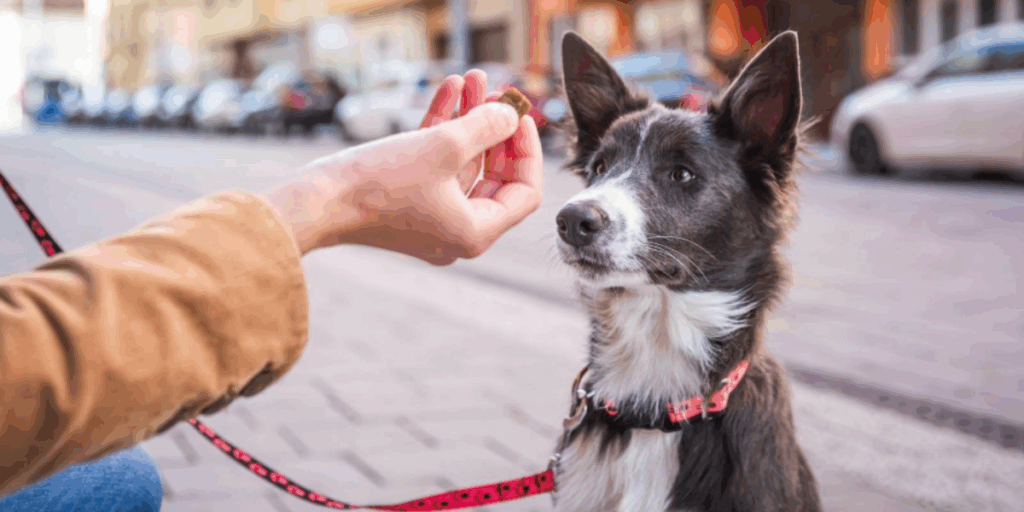
- Come – Reliable recall skills can keep your dog out of trouble when off leash. Use a high value treat, such as our CBD Dog Chews, paired with a verbal cue like “come” or “here,” to train your dog to return to you when called. Make it a fun game by throwing a treat for him to go after and then calling him with the verbal cue to return to you for another treat. Use the cue at unexpected t
- Sit – Teaching your dog to sit can help manage unwanted behaviors. For example, a sitting dog can’t jump, so train your dog to sit when you walk in the door to avoid jumping greetings. Hold a treat close to your dog’s nose while they are standing in front of you and move the treat towards their forehead or back of the head. Your dog will likely try to follow your hand with their gaze and sit down in the process. As they sit, use the verbal cue and give them the treat. Move away to get your dog to stand up and repeat! Never push your dog’s hind end down as it can be intimidating and confusing.
- Down – Similar to sitting, lying down helps to avoid bad behavior like counter surfing and running away. While your dog is sitting, move a treat from in front of their nose down to their front paws. Move the treat along the floor away from your dog until they lie down. Try training this command when your dog is tired—they are already more likely to be on the ground so all you have to do is mark the behavior with a verbal cue and reward.
- Stay – A dog who knows how to stay won’t run into the street or get underfoot while you’re busy, keeping both of you safe. Start training your dog to stay for only a few seconds, giving them a verbal and or visual cue and rewarding them only before they move. If they move, do not reward them and try again. Gradually increase the amount of time and distance you ask them to stay in place.
- Leave it – If you catch your dog before they’ve picked up something, the “leave it” command can prevent them from eating anything harmful or destroying important items. Redirect your dog’s attention with treats or toys, use a verbal cue, and reward your dog when they ignore the object in favor of the treat you are offering.
- Drop it – Like “leave it,” but for cases in which you don’t catch your dog before something is already in their mouth. Give your dog a verbal cue and trade them the unwanted item with something very rewarding so they know that compliance with your command leads to great things. Don’t chase your dog! Your dog can misinterpret this as a fun game.
- Heel – Walking on a loose leash at your side—or heel—is one of the best ways to keep your dog safe. Learning to not pull will also make walks more enjoyable for both of you and is particularly important for large dogs who can overpower their owners. Reward your dog when they walk close at your side. When your dog pulls, walk in the opposite direction, and reward them when they return to your side.
Mastering the three D’s
Your dog may sit on command in the privacy of your own home when you are standing right in front of them. But they will also need to be able to sit in much more challenging situations. So, how can you make sure that your dog will obey these commands 100 percent of the time?
Most trainers consider a dog fully trained with a certain command when they have mastered each of the three D’s:
- Duration refers to the length of time your dog maintains a behavior.
- Distance is how far away you are from your dog when they perform a behavior.
- Distraction involves whatever else is going on around your dog when they do a behavior. Anything your dog finds exciting or disrupting, like another dog across the street or a skateboard rolling by, is a distraction.
As each D increases, it becomes more difficult for your dog to understand how to perform a behavior successfully and the less reliable your dog will be without practice.
The key is to train your dog to increase duration, distance, and distractions very gradually. If all three come into play without your dog having trained for each one individually, the chance of them doing what you ask is slim.
Be sure your dog can handle duration and distance before you start adding distractions. That means training new behaviors in familiar, quiet environments where you are the most interesting thing in the room. Always have high value treats or other rewards with you to keep your dog interested and engaged during training sessions.
Stay positive!
Training should be based on positive reinforcement. Dogs learn best and will repeat behaviors that have a good result. Use high value treats, toys, or praise to reward the behavior you want.
Always keep training sessions brief—just five to 10 minutes—and always end on a positive note. If your dog is having trouble learning a new behavior, end the session by reviewing something they already know and give them plenty of praise and a big reward for their success. If your dog gets bored or frustrated, it will ultimately be counterproductive to learning.
Avoid using punishment such as leash corrections or yelling. Punishment can cause a dog to become confused and unsure about what is being asked of them.
Common training mistakes and how to avoid them
Even with the best intentions, certain missteps in dog training can quietly chip away at your progress. One of the most common is inconsistency. Correcting a behavior one day but ignoring it the next sends mixed signals, making it difficult for your dog to understand what’s truly expected. Consistency in cues, responses, and expectations helps establish a clear and reliable framework for learning.
Another subtle but significant pitfall is switching up the language you use. Saying “come here” in one moment and “come” the next may seem harmless, but for your dog, these variations can muddy the waters. Choose one simple, consistent word or phrase for each command to create stronger associations and faster learning.
Rushing the process is another trap that can derail momentum. Expecting mastery after a single session or introducing distractions too soon can overwhelm your dog and slow their confidence. Instead, start with low-pressure environments and gradually increase difficulty as their understanding deepens.
By sharpening your communication and taking a thoughtful, steady approach, you’ll not only see better results, you’ll also make the training process more rewarding for both of you.
How long does it take for dogs to learn commands?
There’s no one-size-fits-all timeline when it comes to teaching dogs new commands. Some pups pick things up quickly, while others need a bit more repetition and encouragement. Factors like age, breed, and training habits all influence how fast they learn.
Puppies are often fast learners but have short attention spans, so quick, frequent sessions tend to be most effective. Adult dogs may have better focus but might require more time to break old habits. Certain breeds, like Border Collies or German Shepherds, are naturally eager to follow cues, while more independent breeds may need a little extra patience and creativity.
The key to steady progress is consistency. A few minutes of positive, reward-based training each day can be far more effective than occasional long sessions. Basic cues like “sit” or “come” may click within a week or two, while more complex commands, such as “stay” or “leave it,” often take longer to master. Celebrate small wins, stay patient, and remember that progress builds through practice.
When should you start training your dog?
Dogs are always learning. It is never too early to start training basic commands and manners, so start training as soon as you bring your dog home.
It’s also never too late! Old dogs can learn new tricks, and training should be an ongoing process that continues throughout your dog’s life.
Should you seek professional help?
Getting the help of a professional dog trainer can introduce both you and your dog to training and help you communicate with one another. It’s a great opportunity to get expert advice on your individual dog. Ask your veterinarian for recommendations for dog trainers or animal behaviorists.
Group classes can also be an excellent way to get professional training help. The potential added benefits of having other dogs and owners in the room are that your dog will learn to both focus, and also socialize.
There are plenty of reputable books or online training guides that can help you teach your dog good manners and help them manage and understand their world. The Best Friends Animal Society, the Humane Society of the United States, the American Veterinary Medical Association, and Fear Free Happy Homes are all great places for pet parents to start!
Take it up a notch
Basic commands are a strong foundation for more advanced training. They have to know how to lay down before they can learn to roll over!
Training your dog to do tricks, agility, or specific tasks can be great bonding time and provides both mental and physical exercise.